Drive through Maurice, and you will meet the Catalon name sooner or later. It is on mailboxes, church rolls, and town board minutes. Three members of the family have served on the Maurice Board of Aldermen, and together they cover more than fifty years. Five generations on, the name is part of how this town works. But the story starts with one man. He was born enslaved, and he made his way to a stretch of land called Broussard Cove.
His name was Arvillien Catalon, a French-speaking Creole man. Some records spell it Catalan. The name was probably not his choice. It most likely came from a Spanish landowner or a descendant of one, with heritage from Spain’s rule over Louisiana between 1762 and 1800. The United States purchased Louisiana territory from France in 1803. It covered a huge swath of land that would later form many other states. Many freed people carried names like this out of slavery. Arvillien carried his, and over time he made it his own. The records show the name spelled both Catalon and Catalan, but they do not tell us how Arvillien acquired it. What they do show is the life he built and the family he raised. His character was his own, and it would show in the land he claimed and the family he raised.
Freedom raised hard questions, including what a marriage was worth in law. Arvillien had married while enslaved. In 1866, that union was formally recorded in St. Martinville. A newspaper of the day, The Era, explained the problem many families faced. Marriages made under slavery, often performed by “Black ministers,” were not recognized by the law of the time. The 1870 census lists three boys in Arvillien’s home who were likely children of that first marriage. Arvillien later ended it through a civil proceeding and married Felecia Foreman. The 1870 census already lists Felecia as his wife, so their 1872 marriage record may have made official a union that began earlier.
The Promise of Land
Freedom also brought a practical question. How would people who had owned nothing make a living? In March 1865, Congress created the Freedmen’s Bureau and told it to rent forty acres of abandoned or seized land to each freed family. The promise did not last. By April 1866, most of that land had been handed back to its former owners or sold. The late Eunice historian Claude Oubre tells this story in his article “Forty Acres and a Mule: Louisiana and the Southern Homestead Act.”
Congress tried again. In June 1866, it passed the Southern Homestead Act. About 46 million acres of public land in five southern states were set aside for homesteaders only. Louisiana was one of the five. Until the first day of 1867, only freed people and loyal whites could file a claim. The idea was simple. Live on the land, farm it for five years, and it was yours.
Against the Odds
In Louisiana, almost nothing about obtaining a land grant was simple. Historian Claude Oubre estimated that only about 50 of the roughly 200 Black families who filed claims in the state between 1867 and 1870 saw them through. Many claimants faced floods that ruined crops, land offices that were difficult to reach, fees they could not afford, and land that was often swamp, forest, or already claimed.
Arvillien faced an additional barrier. Section 11 had been part of a railroad land grant, which made it unavailable for homesteading. In 1870, Congress declared the grant forfeited and opened the land to settlers.
On March 15, 1873, Arvillien filed his claim. He paid $15.82 for the northwest quarter of Section 11, Township 11 South, Range 3 East. Five weeks later, Maurice Villien filed on the quarter section next door, to the east. Villien is the man the town of Maurice is named for.
Arvillien lived on the land and worked it. On June 7, 1878, more than five years after he filed, he received his final certificate. In December 1879, the United States issued Arvillien a patent for the northwest quarter of Section 11. The patent lists the tract at 161.46 acres and spells his name ‘Arvilien Catalan.’
“A man once listed as someone else’s property now held title to land in his own name.”
Click the following link to see Arvillien’s land patent document:
1879 Sec 11 Catalon Arvillien T11S-R3E NW1:4 13 Dec 1879 (161.46 ac).
Arvillien’s success was rare. Across the five southern states, freedmen filed about 6,500 homestead claims under the Southern Homestead Act. Only about 1,000 of them ever got title to their land. Arvillien also had to hold on through the end of Reconstruction. It ended in 1877, and federal protection left with it. He stayed anyway. He was one of the few who saw it through.
His claim covered a full quarter section, the most the law allowed. Historian Claude Oubre called the failure of freed people to gain land “the tragedy of Reconstruction in Louisiana.” Arvillien’s claim shows what that land could make possible: a place for his family to put down roots. Over the years, he acquired more land in the 4th Ward of Vermilion Parish, around Broussard Cove, and his descendants later helped establish a church and a country store there. Those roots still hold through generations of his family.
A Family Tree Takes Root
Arvillien and Felecia raised a large family. Owning land brought many benefits, but land needed hands. In the late 1800s, Vermilion Parish lived by farming. A large family meant a larger dinner table, and everyone shared in the work of keeping the farm going, as well as its hardships and rewards.
Piecing the family together takes care. Census takers in the 4th Ward wrote names by hand, and many of them spoke little or no French. Names and ages were not always recorded correctly. Still, the census is the best record we have.
The 1870 census shows Arvillien, age 37, living with Felecia, age 20. Three young boys lived with them, listed on the census as Joseph, 13, John, 10, and Maurice, 7. The ages recorded in the census make it unlikely they were Felecia’s children. They may have been Arvillien’s sons from his first marriage, to Eloise (or Loise) Hebert. That union began under slavery and was formally recorded in 1866.
Arvillien and Felecia went on to have nine children of their own: Cordelia Marie (1870), Doris (1872), Leo (1875), Elia (1876), Ignace (1877), Leomire “Ella Mae” (1880), Bernadette (1883), Oscar (1885) and John Ovey (1886). With the three older boys, Arvillien raised twelve children in all. A report published in 1938 listed John Ovey Catalon as one of 185 who passed the Louisiana State Medical Board to become a physician. He was a graduate of Howard University, Washington D.C., and Meharry Medical College in Nashville, Tennessee.
The census tells us more than names. In 1880, it lists Arvillien at 47 and Felecia at 27. Their children appear as Cordelia, 10, Adoris, 7, Elia, 4, Egnace, 2, and Elomir, just three months old. These are Doris, Ignace, and Leomire, or “Ella Mae,” spelled the way the census taker heard them. Arvillien’s age matches the 1870 census, and the children’s ages fit their birth years. Felecia’s does not. If she was 20 in 1870, she should have been about 30 in 1880, not 27. One of the two ages is wrong, and the records alone can’t tell us which.
The census can also show who lived nearby. Census takers went from house to house and numbered each dwelling in the order they visited it. Homes with close numbers were often close on the ground. In the 1870 census, Maurice Villien’s home is number 655, and Arvillien’s is 656. Neither man had filed a claim yet. They were already neighbors three years before they claimed quarter sections side by side. The households that follow include Lessin Trahan, Lewis Micean (Michot), Jules Guidry, Jules Fusilier, and Theodule Mier (Mire). The order shows only the census taker’s route, not exact distances. Still, it gives a picture of a prairie community where Creole and Cajun families farmed as neighbors.
Farming the Land
Those first five years were about getting established. Before anything could grow, the thick prairie sod had to be broken with a plow pulled by a mule or oxen. Arvillien also needed a house, because the law required him to live on his claim. Timber was scarce on the open prairie, so even a small house took real work. Corn came first. It fed the family as cornbread and couche-couche, and it fed the animals. A vegetable garden and a patch of sweet potatoes carried the table through winter. Hogs foraged freely and became meat, lard and sausage. A few cattle could graze the open range, as they did across the prairie.
Arvillien also used ground that might have looked like a loss. The lower end of his quarter section sat low, and rain collected there in what Cajun French speakers call a “platin” (generally pronounced ‘plah-TAHN”. That ground was too wet to plow for corn or cotton. Prairie farmers had a use for it. They scattered rice seed in the standing water and let the rain do the rest. They called the harvest providence rice. It took little labor and no plowing, so it cost him almost nothing in time. Yet it put another food crop on the table and left more of his dry ground for crops he could sell. On a new homestead, where every hour of work counted, that mattered.
During this time, cotton was the crop grown mainly for money. It bought what the farm could not make: coffee, salt, cloth, tools and seed. For those goods, Arvillien would have turned to the country store. Maurice Villien, his neighbor, kept one a short walk from his land. Stores like his sold on credit throughout the year. At harvest, the farmer settled his account with cotton, a calf, eggs, or butter. Arvillien built his farm in hard years for cotton. Its price fell by about half between 1872 and 1877, so each crop he sold brought in less than he might have hoped. A farm that fed itself could survive that. Most farmers at the time grew most of their family’s food. Arvillien most likely did the same, helping manage his family’s costs.
Generations Later
Many of Arvillien’s descendants stayed in the Maurice area. His son Doris was born in 1872, the year before Arvillien filed his claim. Doris grew up on the homestead and farmed Catalon land. In 1946, he sold a parcel of land for a Catholic church. St. Joseph Catholic Church still stands there today.
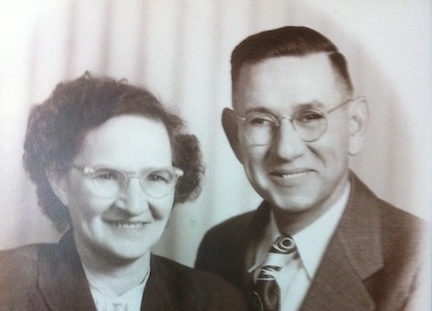
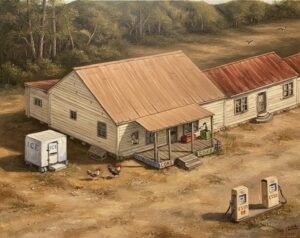
That same year, Doris’s son, Paul Eldridge Catalon Sr., built a country store right beside the church. Everyone called him Son, pronounced “Sawn.” He was born in 1913, the year after his grandfather Arvillien died. Son and his wife, Emma Mouton, lived at the store and ran it for nearly 40 years. They were respected citizens of Maurice and served on many public boards. Son died on February 28, 1984, at age 70. Emma died ten years later, in 1994. The store burned in 2004, and what remained was removed. Today, Son’s granddaughters have built a food truck park on the site, in the spirit of their grandfather’s country store.
Their oldest son, Paul Eldridge Catalon Jr., served in the Navy. He married Doris Marie Clement of Kaplan, and the couple lived there during his service before settling in Maurice. In 1974, Paul ran for alderman of the Village of Maurice. No one ran against him. He joined Golden Landry and Jean Dudley Trahan on the three-member board. Paul once said he wanted to stay active and believed he could make a difference. His years in the construction business gave him a practical eye as Maurice grew. He served on the board for 30 years, until he died of cancer on July 13, 2004.
Two days later, Aldermen Gary Villien and Darin Desormeaux appointed Paul’s son, Troy Catalon, to fill his father’s seat. Troy finished that term and won a full term of his own, serving six years in all. When work took him out of town in 2010, his sister, Phyllis Catalon Johnson, ran for the board and won. She served for 12 years.
In 2022, Maurice grew from a village into a town, and the board expanded from three members to five. Troy was appointed to one of the new seats, and for the rest of that year, brother and sister served together. “My family has long been involved in our community,” Troy said at the time. Phyllis stepped down at the end of 2022. Troy has served ever since and won re-election in 2026.
Later generations sold portions of the family’s land. Catalon descendants still manage a considerable amount of land in the Maurice area, though less than the family held in the early 1900s.
Arvillien’s homestead began with a 161.46-acre tract and five years of persistence. His family made a life there, and later generations helped establish a church, a country store, and a tradition of service to Maurice. Catalons have served on the town’s governing board for more than 52 years. The land Arvillien worked to secure became part of the community his descendants continue to serve. His perseverance gave them a place to begin; their work made it part of Maurice.
Special thanks to the following individuals who supported the research to develop this story.
Troy Catalon, a descendant of Arvillien Catalon, Maurice, LA
Doug Villien, a descendant of Maurice Villien, Baton Rouge, LA
Public Service Department, Vermilion Clerk of Court, Abbeville, LA
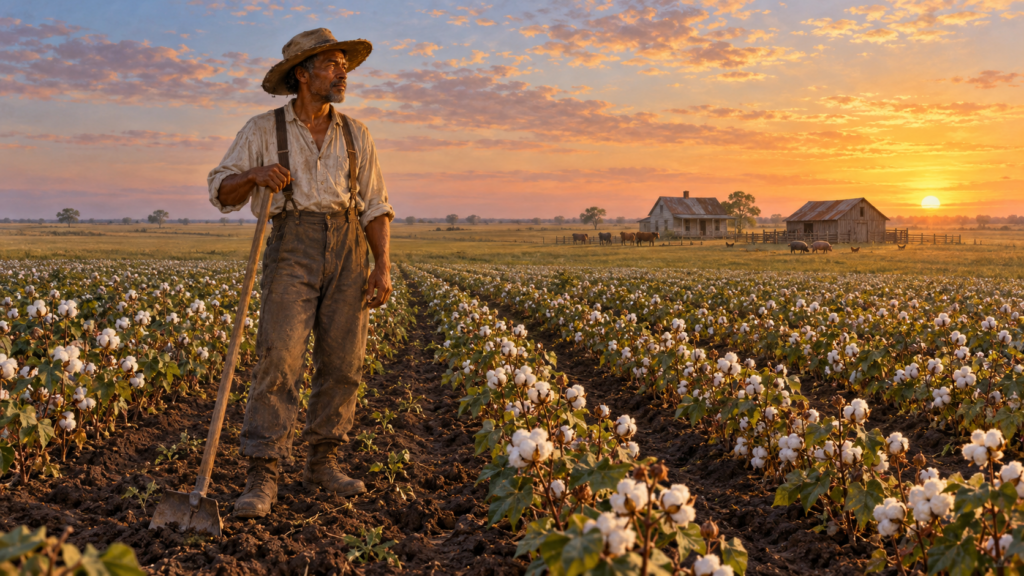
Note: The cover image is an AI-generated illustration. This imagined depiction of Arvillien Catalon in 1873 is intended to evoke the period, not to represent a verified likeness.