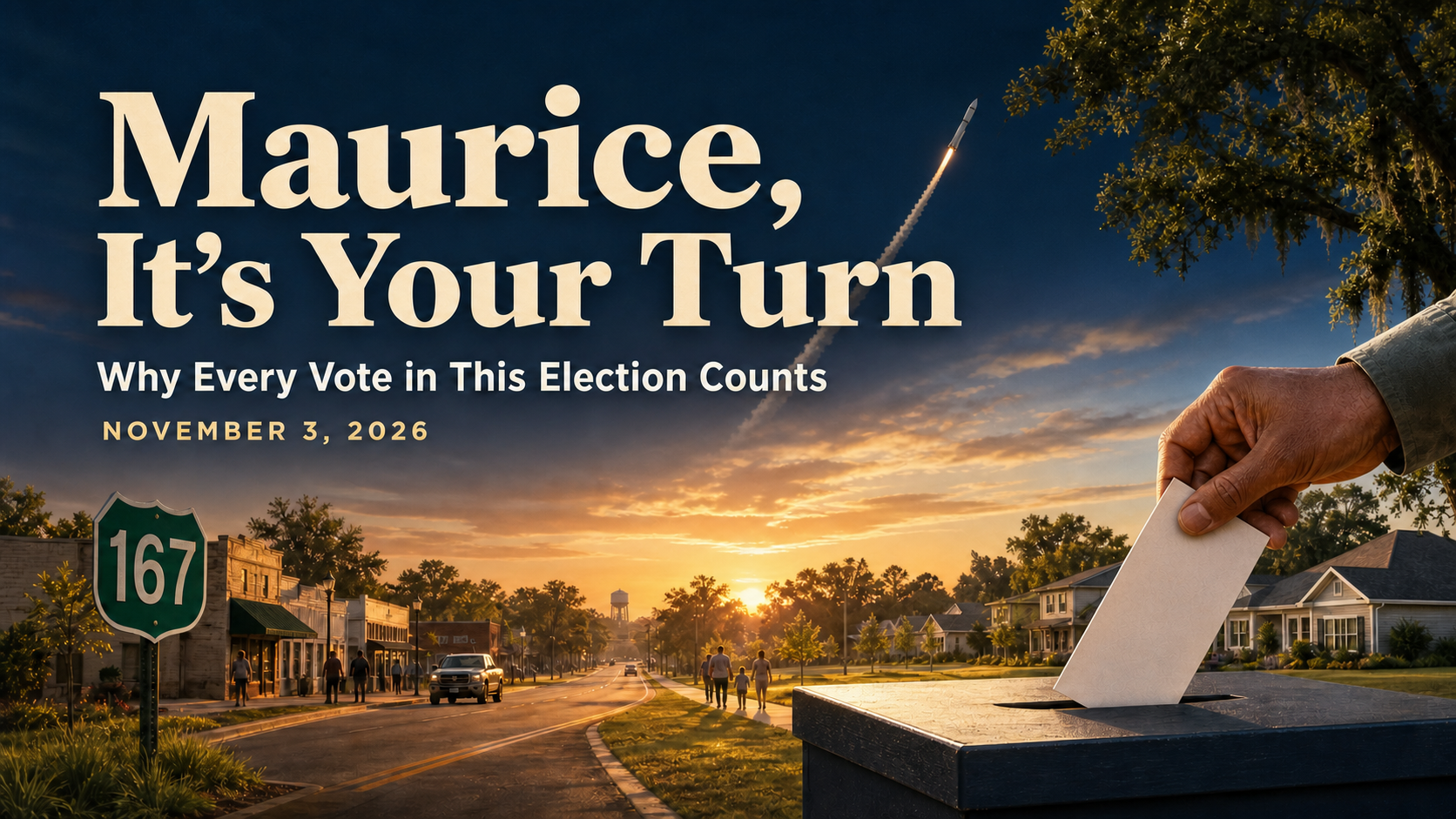
In August, the state of Louisiana announced that SpaceX will spend $100 billion building a rocket launch site at Pecan Island, about 40 miles south of Maurice on the Vermilion Parish coast. It is the largest industrial project in state history. It is expected to bring 3,000 direct jobs and roughly 8,100 more in support work, with construction starting in 2027, or sooner, and the first launch targeted for 2029.
As part of the deal, Vermilion Parish is set to receive a $20 million upfront payment plus $25 million a year for 25 years, with the annual amount rising over time, more than $820 million in direct payments over the life of the agreement. That money is split three ways, between the Police Jury, the School Board, and the Sheriff’s Office for police services, though parish leaders have said the exact division is still being worked out. Splitting one new revenue stream fairly across three separate government bodies is no small task, and it wouldn’t be a surprise if the parish brings in outside financial help to sort it out, though nothing on that front has been made public.
For scale: the Vermilion Parish Police Jury, the parish’s governing body, collected $21,287,766 in combined property and sales tax in all of 2024. Public officials with the Parish have indicated the additional money will be earmarked for roads, bridges, schools, police protection, and other civic projects across the parish.
Pecan Island is not Maurice. But get out a map and look at how you get there. US Highway 167 runs south out of Lafayette and straight through Maurice before it ever reaches Vermilion Parish. That makes Maurice the parish’s northern gateway, the first town anyone coming down from Lafayette passes through, whether they’re a SpaceX engineer, a construction crew, a supplier hauling steel, or a family looking for a place to live within driving distance of a 10,000-job project. Every one of them comes through here first.
Maurice was already growing before this. Different counts put the growth since the 2020 census somewhere between 40 and 50 percent, enough to make Maurice the fastest-growing town in Louisiana on its own. Roads were already getting busier. Schools were already filling up. Now add in $820 million coming to the Parish governmental entities from SpaceX Louisiana just 40 miles down the same highway that runs through the middle of town, and the growth this town has seen so far starts to look like the warm-up act.
Somebody has to make the calls on what comes next: the roads, the zoning, the drainage, the policing, all of it, for a town that is about to become the front door to the biggest thing happening in this part of the state. This November, that somebody gets decided by you, the voter.
What the “Gateway” Actually Means
It is worth sitting with what “gateway” means in practical terms, because it is not just a nice word for a map location.
Commerce follows traffic. A project pulling thousands of workers and contractors down US 167 every day means new demand for gas stations, restaurants, hardware stores, and rentals along that corridor, and Maurice sits at the first exit off that demand. Population follows commerce. Workers who don’t want to live on the coast, and don’t need to live in Lafayette, will look at the towns in between. Maurice is the closest one to Lafayette’s jobs, schools, and airport, which makes it the natural landing spot. And infrastructure follows population. More people and more truck traffic on the same roads, the same drainage systems, and the same schools that are already stretched thin from the growth of the last five years.
None of this is guaranteed to happen exactly this way. But it is the direction every piece of this points, and it is the reason the people elected this November are not just managing a small town’s usual business. They are managing the front door for the parish, whether the town asked for that role or not.
Who’s Actually on the Ballot
Three offices are up this year: mayor, police chief, and the five seats on the Board of Aldermen. Not all three are equally in play. Mayor Neil Arsement qualified without an opponent, so that seat isn’t in question. Worth saying plainly: running unopposed isn’t nothing. In a town this size, where everybody knows everybody, if nobody steps up to challenge you, that usually means people are fine with the job you’re doing. That’s its own kind of vote of confidence. The other two races are the ones actually in question, and they are exactly the offices that will handle what’s coming: the chief who runs the police department managing more traffic and more people, and the council that sets zoning, drainage, and budget priorities for a town about to feel real growth pressure.
For police chief, Guy Nerren and John Dayries both qualified, and whoever gets more votes wins the job outright. For the Board of Aldermen, six people qualified for five seats. One of them will not win. In a field that size, in a town this size, the difference between winning a seat and losing one could come down to a handful of ballots. Your vote isn’t a drop in the bayou here. It’s closer to a full vote out of a room, at the exact moment this town needs the right people in that room.
Town Council Voting Process
Town council elections work differently than the mayor’s race, and that difference often confuses voters. In Maurice, five aldermen are elected in a single, at-large contest using a “top five” format. All qualified candidates appear on the same ballot, not in separate seat-by-seat races, and voters can choose up to five names. After ballots are counted, the five highest vote-getters win the seats. There’s no runoff, because candidates don’t need to reach 50 percent. Finishing in the top five is what matters.
This year, six people qualified for those five seats. That means one candidate goes home no matter what. So when you vote for council, don’t think of it as picking one favorite. Think of it as building your own team of five, the team that will be writing the zoning and drainage rules for a town about to sit at the edge of the state’s biggest construction project. Every one of those five votes matters on its own, and with six names in a five-seat race, the margin between winning and losing could be as thin as it gets. The six candidates are: Troy Catalon; Megan-Landry Lalande; Jonathon Schlicher; Wayne Theriot; Matthew Trahan; and Scott Trahan.
Maurice’s History of Civic Pride
This town has always been personal. Maurice started as Mauriceville, named after its founder, Maurice Villien. Villien came from Savoy, France, in 1855. He and his wife settled here around 1868, three miles west of Milton, and built a home and a store along a wagon road. That store became the center of the whole town.
Villien didn’t just found the place and leave. His family stayed involved. When Maurice was formally incorporated on December 27, 1911, his son Joseph Villien became its first mayor. Joseph held that office until 1928, close to two decades. The people who built Maurice were the same people who ran it.
That pattern held for generations. Maurice has stayed small enough that its elected officials aren’t strangers. They’re the people at church, at the corner store, at the high school sporting event. That closeness is part of what makes this town work. It’s also exactly why your vote carries weight. When the person you elect is someone you’ll see at the grocery store next week, the choice isn’t abstract. It’s personal, the same way it was for the Villiens, and it stays personal even as the town starts considering the impact of a project with a $100 billion budget.
The Math Doesn’t Add Up
Here’s the math that should worry you. Maurice has an estimated 3,500 residents old enough to vote, according to figures from the Vermilion Parish Registrar of Voters. Only about 1,700 of them are registered. That’s less than half.
Now add turnout. Local elections almost never generate a high turnout. Off-year and municipal races in Louisiana often draw somewhere around 18 to 20 percent of registered voters, sometimes less. Apply that to Maurice’s 1,700 registered voters and you get roughly 300 to 350 people actually showing up to vote.
A winning candidate only needs a little over half of those votes, and in the aldermen race, a fraction of that to land in the top five. That means the police chief and council members who will decide how this town expansive growth, and how it capitlizes a $100 billion parish project could be chosen by a couple hundred votes.
Two hundred votes, give or take. Out of 3,500 eligible citizens. That’s not even one in ten people deciding for everyone else, at the exact moment those decisions are about to matter more than they ever have in this town’s history.
This isn’t a knock on the system. It’s the reality of small-town turnout everywhere. But it means the leverage of a single vote in Maurice is enormous, and it’s about to get more consequential, not less. If you’re one of the roughly 1,800 residents who aren’t registered, you’re not a bystander. You’re most of the reason these races get decided by so few. And if you are registered but plan to sit this one out, know that your one vote might be worth what a hundred votes are worth in a bigger city race, at a moment when this town cannot afford to leave those decisions to a handful of people.
That’s the real story behind “every vote counts” here. It’s not a slogan. In Maurice, it’s arithmetic, and the stakes just changed.
Registering to Vote Is Easy
Registering to vote takes less time than a trip to the grocery store. If you’ve got internet access, the GeauxVote website (www.geauxvote.com) lets you register in a few minutes, no envelope, no stamp, no drive to Abbeville required. Prefer paper? You can register by mail or walk into any OMV office and do it on the spot while you’re there for something else.
For this November’s election, the deadline to register online is October 13, 2026. If you’d rather register in person or by mail, get it done by October 5, 2026. Either way, it takes less effort than most people spend deciding what to watch on TV tonight. There’s no excuse tied to time or hassle. The only thing standing between an unregistered neighbor and a vote that could help decide how Maurice handles its new role as the gateway to Vermilion Parish’s biggest project ever is five minutes and a decision to act.